
Connecting Zoho CRM lets Personyze read your CRM contact and lead data and use it to personalize the website. Job title, company, industry, lead status, pain point — anything on the Zoho record becomes something you can target on, write into page copy, and A/B test.
That makes it an ABM tool: target named accounts and roles with specific messaging, content and calls to action.
In the panel: Settings › Integrations › Zoho CRM.
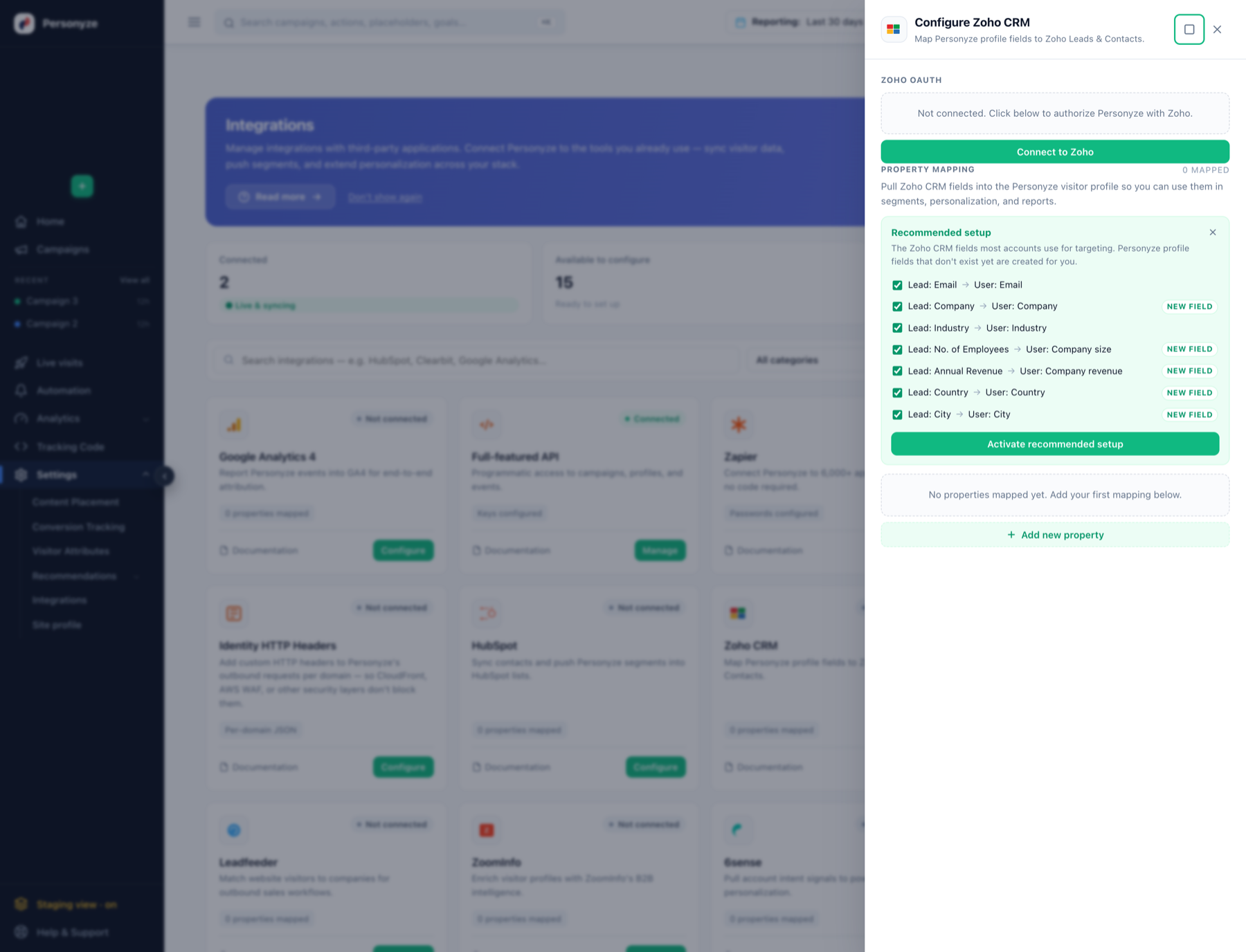
Connecting
Zoho uses OAuth only. There is no API key to generate or paste.
- Open Settings › Integrations and click Configure on the Zoho CRM card.
- Click Connect to Zoho. A Zoho window opens.
- Sign in and approve access.
- The drawer then shows the connection as active.
To disconnect, do it on the Zoho side first. Open the Zoho admin, find the Personyze connection and click Manage there, then disconnect in Personyze. Removing it only in Personyze can leave the authorization dangling in Zoho.
Mapping the fields
Connecting authorizes the read; property mapping decides which Zoho fields land on the Personyze visitor profile, where they become available to segments, personalization and reports.
Use Activate recommended setup for the common fields — name, email, company, industry — then add your own. Personyze profile fields that do not exist yet are created for you and marked NEW FIELD.
Adding your own fields
- In Zoho, open the field and note its API name — not the display label.
- In Personyze, add a new mapping, enter that API name, and choose the Personyze profile field it should fill.
- Save.
The drawer header shows a live count. 0 properties mapped means no Zoho data is reaching profiles, however healthy the connection looks — this is the most common reason a Zoho-based rule matches nobody.
Using the data in targeting
On a campaign’s Target step, Add audience rule gives you two routes:
- The Integrations tab — this provider’s own rule entry, with a connection indicator. Every provider is listed whether or not it is connected, so read the marker.
- User CRM/ABM/Profile — any field you mapped, with the full operator set: contains, doesn’t contain, equals, doesn’t equal, is one of (list, file), is not one of, matches regex, starts with, ends with, is empty, is not empty.
Negative operators only match visitors who have a value. Someone with no data for that field will not match “industry doesn’t equal Retail” — use is empty for them.
Using the data in content
Mapped fields become dynamic variables in the WYSIWYG editor, so they can appear in the copy itself. Always set a fallback value — a variable with no default renders blank for anyone missing that field. See inserting dynamic variables.
A/B testing on it
Build the audience with the rule, then switch on Activate A/B testing on the Content step. The first test worth running is personalized versus generic to the same audience — it answers whether the integration earns its keep. See A/B Testing.
When nothing seems to happen
- 0 properties mapped. Connecting alone does nothing.
- Mapped the display label instead of the API name.
- The visitor is not identified. CRM data only attaches once Personyze knows who the visitor is — by email captured from a form, URL or cookie. An anonymous visitor has no CRM record to match.
- A negative rule matches nobody. Add is empty.
Related
- HubSpot Integration — the same pattern for HubSpot.
- CRM / User-List Targeting
- Adding custom user profile fields