
A Cart Abandonment Emails campaign writes to shoppers who left products in their cart, with those products and others they may like. A great deal of potential revenue is lost in carts nobody comes back to, and this reminder brings part of it back. Start it from New campaign → Cart Abandonment Emails. It is an email campaign with steps of its own; Email Campaigns — One Email, a Sequence or Text Messages covers what it shares with the others.
The nine steps
The first three are what every reminder depends on — the shopper’s email address, your products and the cart itself — and they belong to your account, not to this campaign. The rest build the email and check it before anybody gets one.
| Step | What it is for |
|---|---|
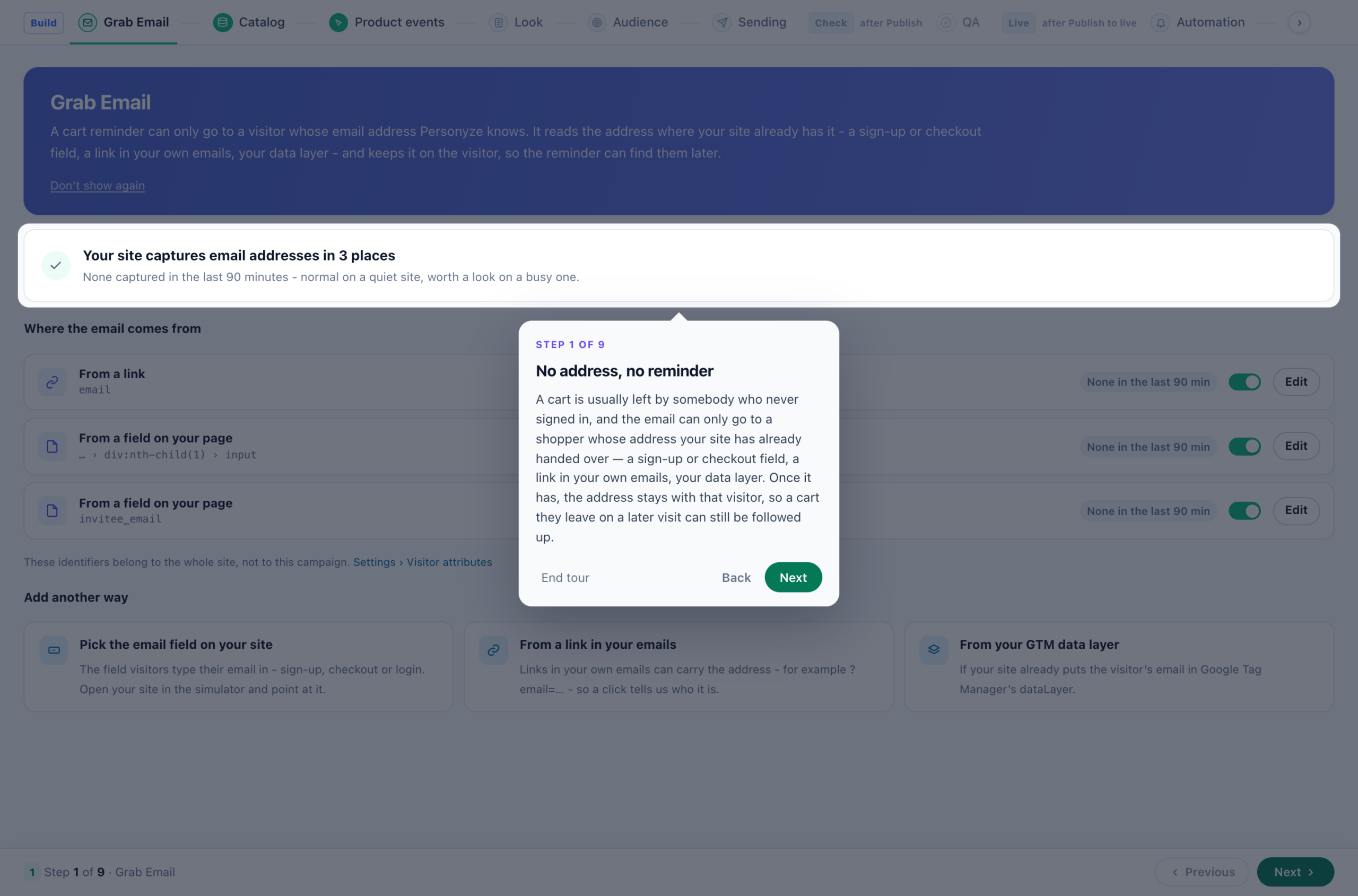
| 1. Grab Email | A cart is usually left by somebody who never signed in, and the email can only go to a shopper whose address your site has already handed over — a sign-up or checkout field, a link in your own emails, your data layer. The step says where your site captures addresses. Once captured, the address stays with that visitor, so a cart they leave on a later visit can still be followed up. |
| 2. Catalog | The products in each email — picture, name, price and link — come from your catalog, not from the page the shopper was on. A product with no picture or link there is an empty card in somebody’s inbox, and the step says how many of yours are missing one. |
| 3. Product events | Added to cart says who to remind and which products to show them; Purchased stops the reminders once they buy. Without the first the campaign reaches nobody; without the second it keeps writing to people who have already paid. Product views only fill the email’s “You may also like”. |
| 4. Look | Pick a template for the email, then go through its tabs. The last one, Timing, is when it goes: it starts out an hour after the cart was left, once per cart, and not at all if the shopper buys first. Change any of it there. |
| 5. Audience | Rules run against the people Personyze knows by email, not against who is on your site: a shopper matches once they have left, which is when a reminder is worth sending. See Has products to show in the email. |
| 6. Sending | Who the email is from and where replies go. Your domain, mailing address and unsubscribe page are the account’s, set once for every email campaign. Send yourself a test here — see The Sending step. |
| 7. QA | Find a shopper who left a cart: Preview by user renders the email exactly as they would get it, and can send you a copy of that very message. Sample recipients shows who matched at the last check. |
| 8. Automation | Not a schedule but a watch on the numbers: what counts as going wrong — a rate falling, revenue drying up — and whether Personyze should tell you or act on it. |
| 9. Performance | The cart-abandonment figures, then the email’s report — see Reading an email campaign’s report. |
Has products to show in the email
When you save, the Audience step gets a rule you did not write: Has products to show in the email. It runs the email’s own product block for each shopper, so somebody it would have nothing to show is not sent an empty email — and matches the moment they have something.
- It is added only where the email’s products can run out. An email without a product block, or one whose block has fallbacks, does not get it.
- Deleted by hand, it comes back at the next save: an email with nothing in it cannot be sent anyway.
Publishing
Live means sent, and sending cannot be undone. Publish to staging promotes this version to the staging audience only, so you can check it without anybody receiving it. Publish to live sends it — to everyone matching now and to anyone who comes to match later — and turning the campaign off afterwards may not stop messages already handed to the sending service.
Related
- Email Campaigns — the email steps every email campaign shares
- Reading an Email Campaign’s Report
- Use case: cart abandonment
- Tracking product events — Added to cart and Purchased
- Targeting People by What They Did With an Email