
Personyze’s algorithms learn cross-sells from behaviour — “people who bought X also bought Y”. That works for an established catalog with purchase history. It does not help a product launched yesterday, or a pairing you know better than the data does. For those, you state the pairs yourself.
Where: Settings → Recommendation setup → Product Catalog → Manual recommendation rules → View rules. Three optional sections open: Manual cross-sell links, Manual up-sell links and System-generated cross-sell — seed data.
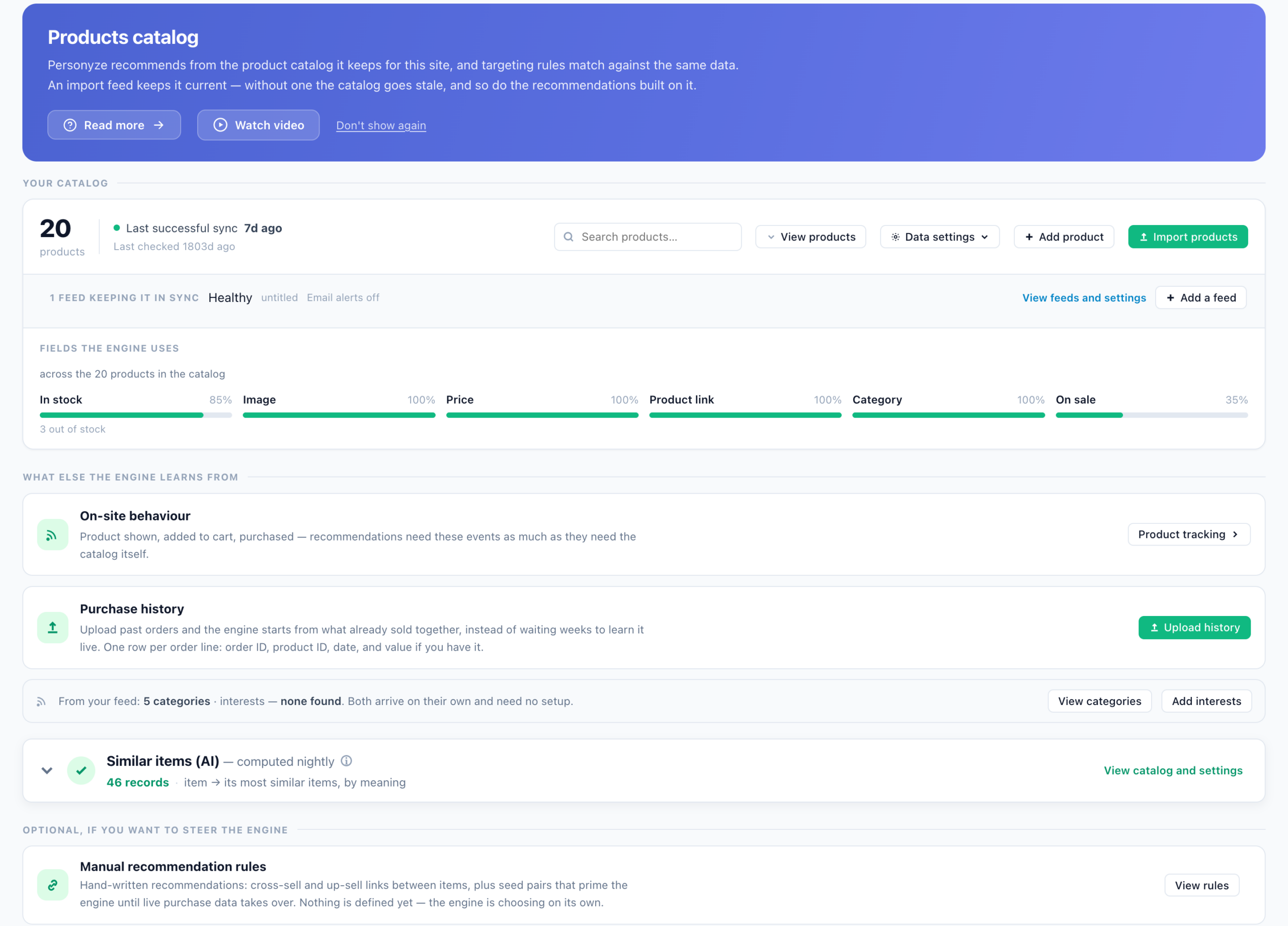
When your own pairs are the right fit
- New product launches — no purchase data exists yet, but you know what goes with the new item.
- Strategic bundles — a phone with this case and this charger, whatever the data alone would surface.
- Margin — pair your highest-margin accessories with high-volume products, even when other items are more popular.
- Editorial picks — your merchandisers know the pairings the data misses: camera, lens and bag.
- A fallback behind “bought together” — when a learned cross-sell comes back empty for a new product, your pairs still fill the widget.
Cross-sell and up-sell links
| Section | Pairs | Used by the picker card |
|---|---|---|
| Manual cross-sell links | base → recommended item | Managed Cross-Sells |
| Manual up-sell links | base → higher-value item | Up-Sells, based on your uploaded up-sell catalog |
Each section shows Configured once it has pairs, Not set until then. Add pairs by hand with New link — pick the Subject products and the Linked products, and every combination becomes a link — or Import a CSV or TSV file and map its two columns. One link per row, both products by Internal ID:
Subject Internal ID,Linked Internal ID
AQB14X,AQB15X
AQB15X,AQB14X
BARR4FJ3,LABAR4114
📥 Download the cross-sell / up-sell template — the same file works for both sections.
- Links are one-way. To recommend two products to each other, add both rows, as in the first two above.
- One partner, many subjects. A charger or a case can be linked to every phone it fits. There is no limit per subject; a widget typically shows 3–5.
- Export downloads the pairs in the same two columns, and Find internal ID searches them.
Using them in a widget
In a recommendation campaign’s algorithm picker, both cards sit in the Cross-Sells, Co-Views & Upsells group:
| Card | What it shows |
|---|---|
| Managed Cross-Sells | “Cross-sells from a catalog you upload and maintain yourself.” On the Home page it reads the pairs of every product the visitor viewed; on a Product page, the recently viewed item; on Cart, the cart contents; on Thank you, the order. |
| Up-Sells | “Higher-priced alternatives to the current product or cart items.” On a Product page, Based on defaults to your uploaded up-sell catalog (its other choices are learned from behaviour). On Cart and Thank you it always reads your up-sell links. |
As a fallback. In the editor’s Output card, Fallback algorithms → Add fallback can put Managed Cross-Sells behind a learned cross-sell such as Cross-Sells or Last Bought Item: Those Who Bought This Also Bought. See Setting Recommendation Fallbacks.
Common placements: a product-page “goes well with” widget and a cart “complete your setup” widget. In email campaigns, Up-Sell for Bought Items (in the Made a purchase group) reads your up-sell links.
Seed sets: priming the engine
System-generated cross-sell — seed data primes the learning algorithms before they have seen real purchases. A seed set tells Personyze that a pair of products was interacted with together, as if real users had done it, and the engine recommends them to each other until live purchase data takes over. It suits a brand-new catalog with no behaviour yet.
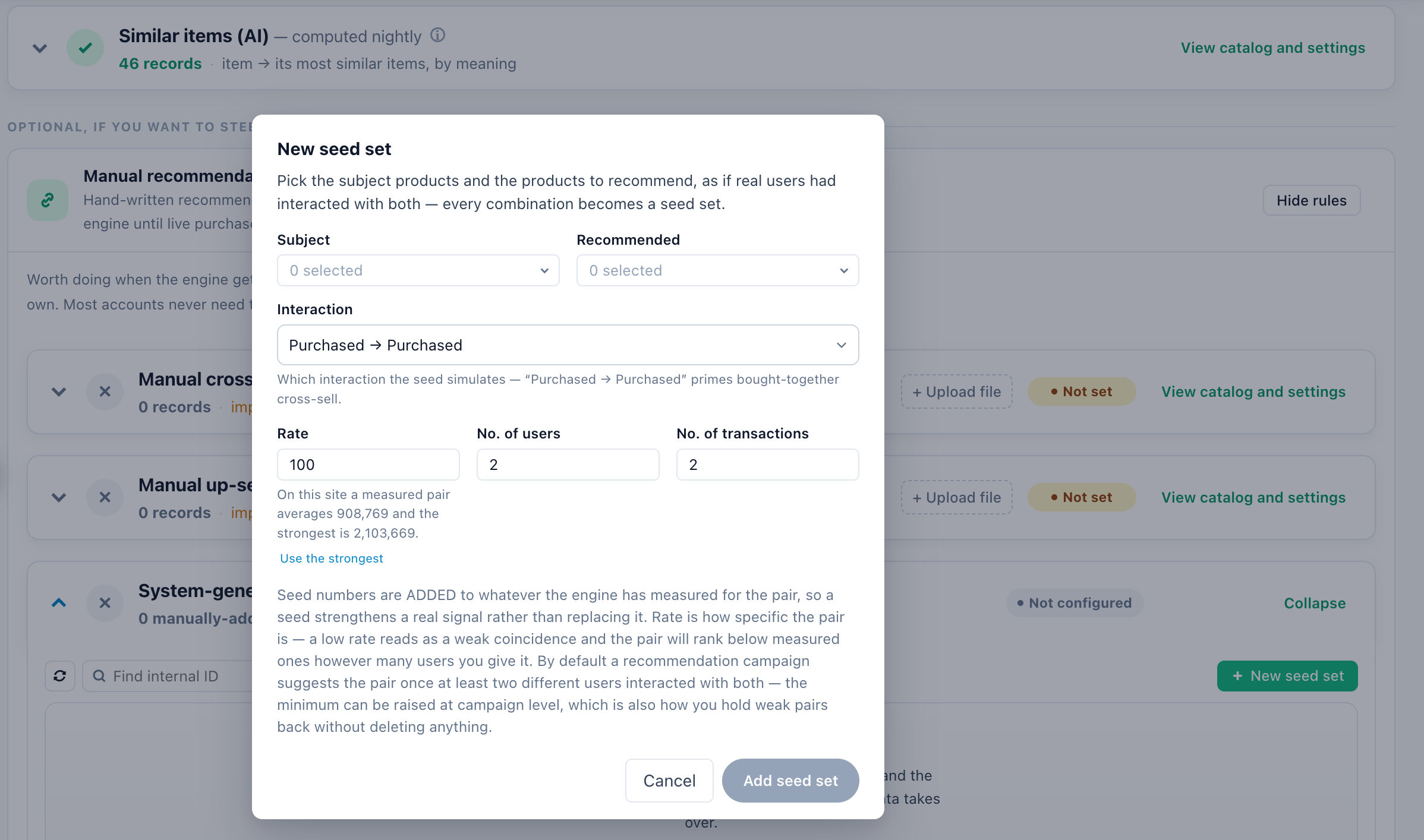
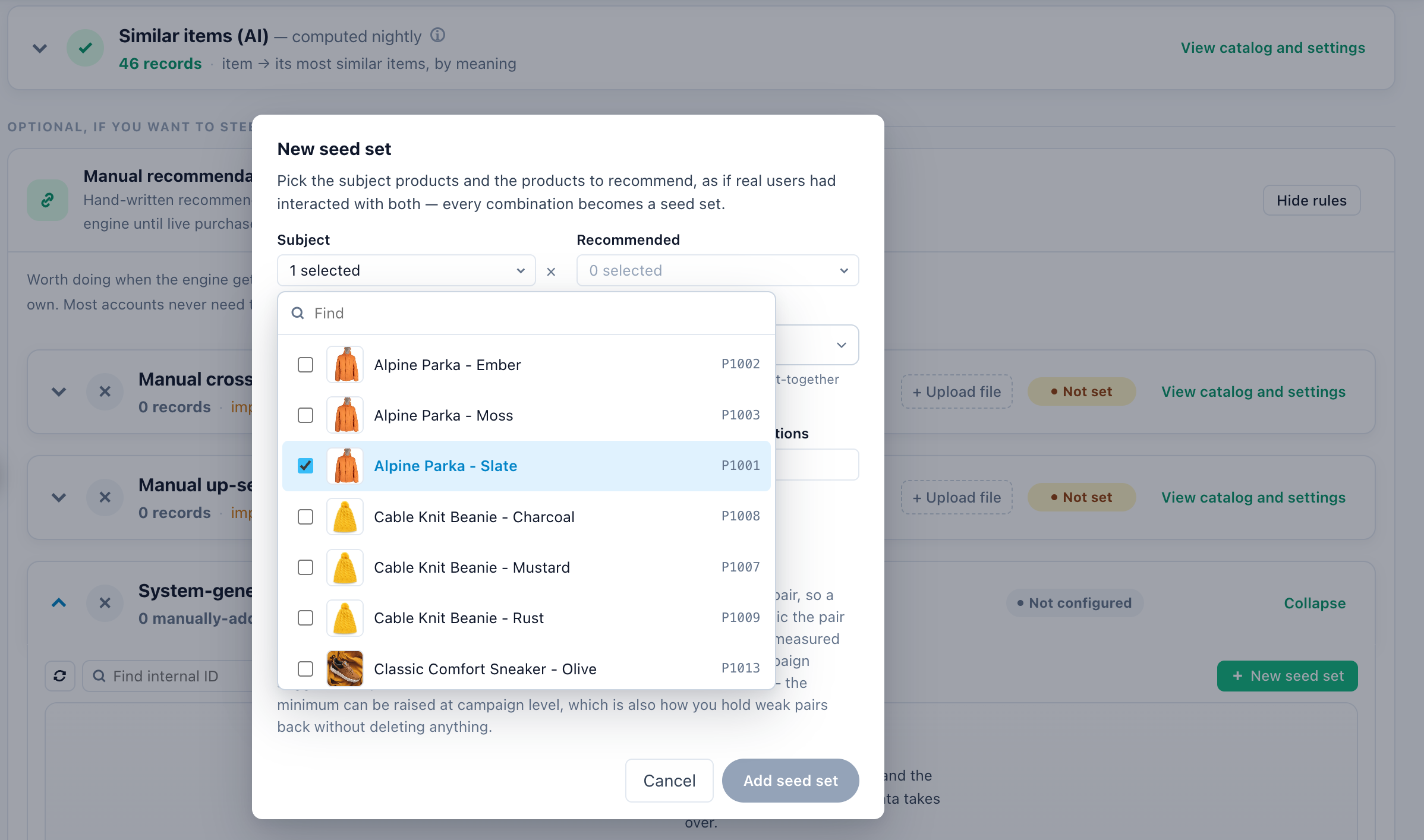
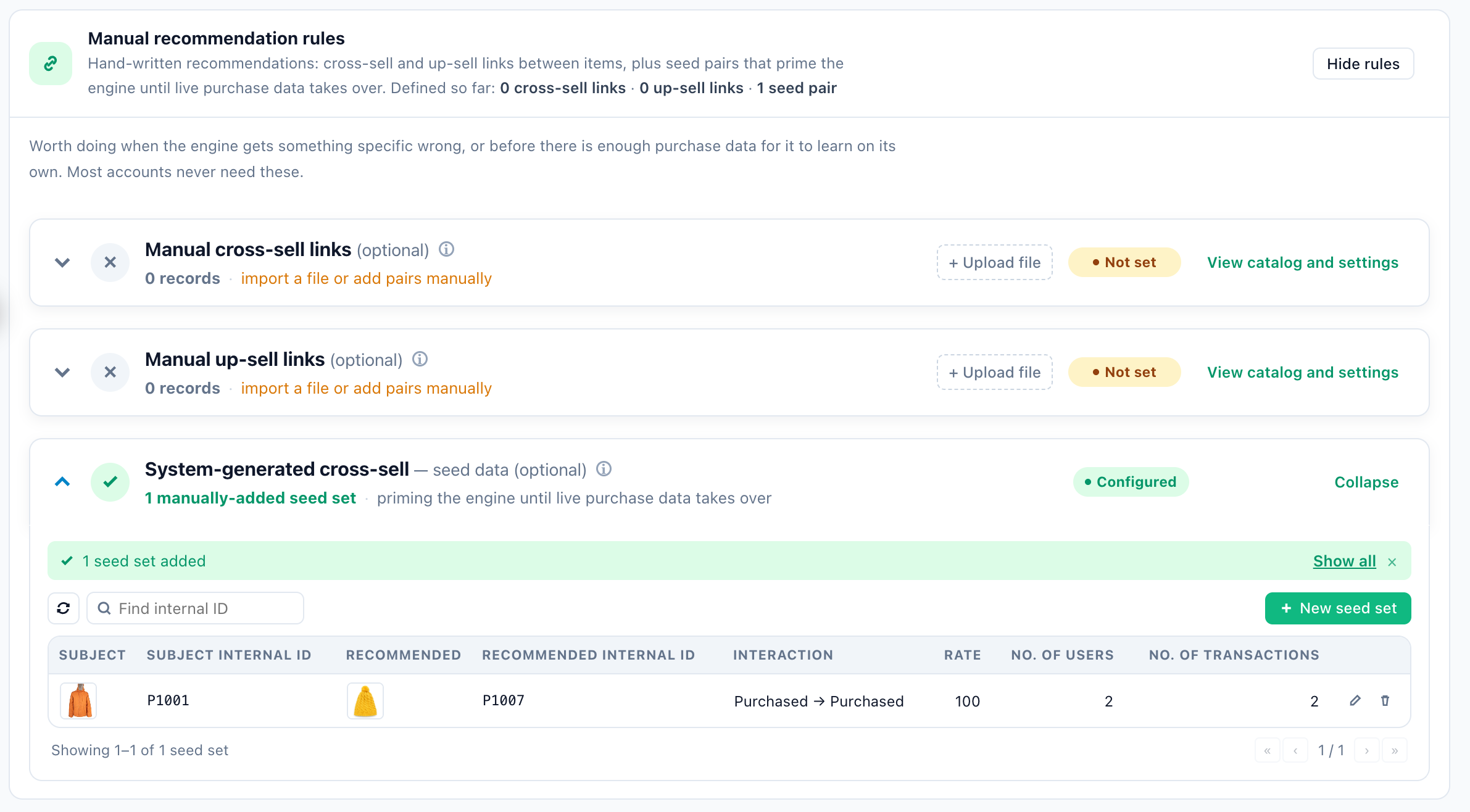
- Seeds add to what is measured. In the dialog’s words: “Seed numbers are ADDED to whatever the engine has measured for the pair, so a seed strengthens a real signal rather than replacing it.”
- Give it at least two users. By default a recommendation campaign suggests a pair once at least two different users interacted with both.
- Rate is how specific the pair is. A low rate reads as a weak coincidence and ranks below measured pairs however many users you give it. When your site has data, the dialog shows the average and strongest measured pair, with Use the strongest.
- Seeds feed the learned cards, such as Cross-Sells. Managed Cross-Sells reads only your links.
- To change a seed set, edit its numbers; setting all three to 0 deletes it.
Best practices
- Mix your pairs with learned ones. Use your own for hero products and strategic pairings; let learned cross-sells handle the long tail.
- Refresh at least monthly. Old items come back to haunt you when they surface as partners of current products.
- Audit subjects that lost their pairs. After each import, export the links or search with Find internal ID, and check your key products still have partners. A subject with none gets nothing from this card — only what the widget’s fallbacks return.
- A/B test your pairs against learned ones. Run Managed Cross-Sells and a learned cross-sell as two variations on the same pages before committing to one approach catalog-wide.
Related
- Setting the Product / Content Feed — the catalog screen these sections live on.
- Recommendation Algorithms — every picker card.
- Uploading Feeds & Data Files — file formats and SFTP.
- Buy Together — a bundle design for cross-sells.