
Inspire me reads your website the way a new visitor sees it and writes you a personalization plan. It works out which audiences your site could tell apart, checks every Personyze feature against your pages, and suggests the campaigns worth running. The best ideas are drawn on pictures of your own pages, once for each kind of visitor who would see them. Any idea can then become a campaign in your account.
It takes a few minutes, and there is nothing to install: it reads your public pages in a real browser.
Where it is
- In the panel: Inspire me in the left sidebar.
- From New campaign › Let AI suggest campaigns.
- Without an account: the free scan at www.personyze.com/inspire/ (see The free scan below).
Run a plan
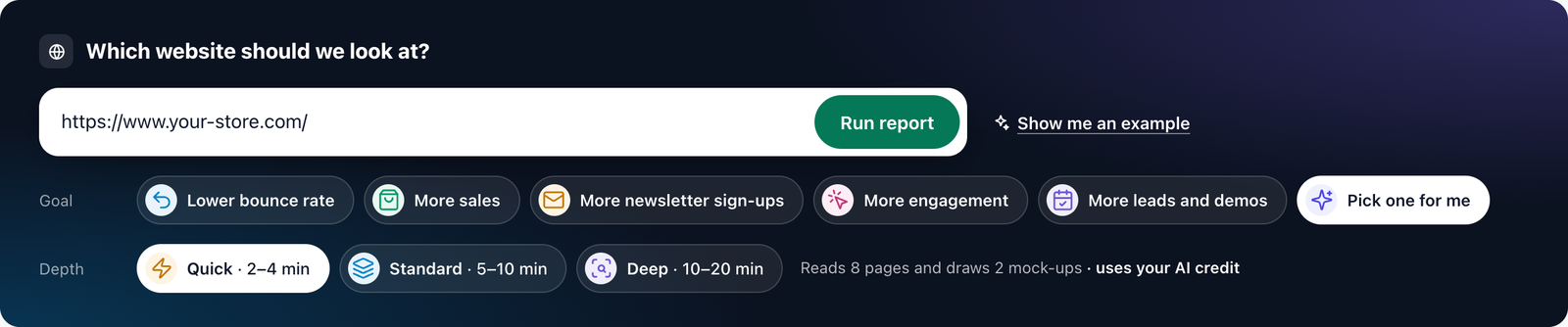
- Website. Your account’s sites are offered first; any public page works.
- Goal. Lower bounce rate, More sales, More newsletter sign-ups, More engagement, More leads and demos, or Pick one for me, which chooses the goal that fits your site.
- Depth. How much of the site it reads and how many ideas it draws by itself:
Depth Takes about Reads up to Draws by itself Quick 2–4 minutes 8 pages 2 mock-ups Standard 5–10 minutes 20 pages 3 mock-ups Deep 10–20 minutes 40 pages 4 mock-ups - Click Run report. You can leave the page: the bell tells you when the plan is ready.
What it costs. Your account’s first Quick or Standard plan is free; the line under the depth says free – your first plan. Every later plan, and every Deep plan, uses your account’s AI credit, as do the mock-ups and landing pages you ask for afterwards. If the credit has run out, the page says so, with a link to add more.
One plan of an account is made at a time. A plan is written in your panel’s language; your site’s own words are quoted as they are.
What it reads
- Your home page, and the page that matters most for your goal. That is a product page for more sales, pricing or a demo page for more leads, an article for sign-ups and engagement, and a category page for a lower bounce rate. The plan is scored on these two pages.
- Then more of your site, up to the depth’s number of pages. It skips pages a visitor’s plan can’t use: log-in, account, cart, checkout, help, legal and job pages.
- Only what a first-time visitor sees, on a computer. It can’t see pages behind a log-in, or personalization that shows only to other visitors.
- In your own account, your own data too:
- the campaigns already live, so they are not suggested again;
- the audiences Audience Discovery found in your visitors;
- the landing pages losing the most visits;
- the products viewed most but rarely bought.
Every claim is checked. After the plan is written, each finding, idea and page note is checked again against the pages read. Anything the pages don’t support is left out of the plan.
Reading the plan
The scores
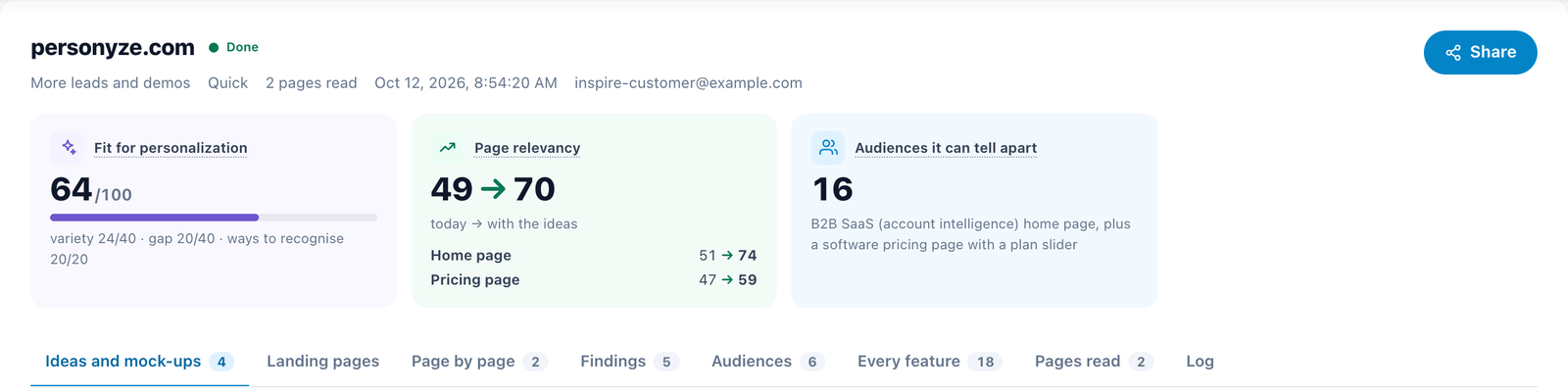
- Fit for personalization (out of 100): how much your site stands to gain. It adds up how many audiences your visitors fall into (up to 40), how far your pages are from serving them today (up to 40), and how many ways Personyze has to recognize them (up to 20).
- Page relevancy, today → with the ideas: how well your scored pages match what each audience came for, weighted by each audience’s share of visitors. The first number is the pages as they are; the second is with the plan’s ideas live. Each scored page has its own pair of numbers under them.
- Audiences it can tell apart: how many distinct audiences personalization could tell apart on your site, with a line on how they were counted.
Ideas and mock-ups
Four to six ideas, best first, spread across your scored pages. Each idea shows:
- the page it is for;
- the Personyze feature it uses, and the data that recognizes the visitor;
- Who sees it, Where on the page, Why (pointing at something on your page), and how to Measure it.
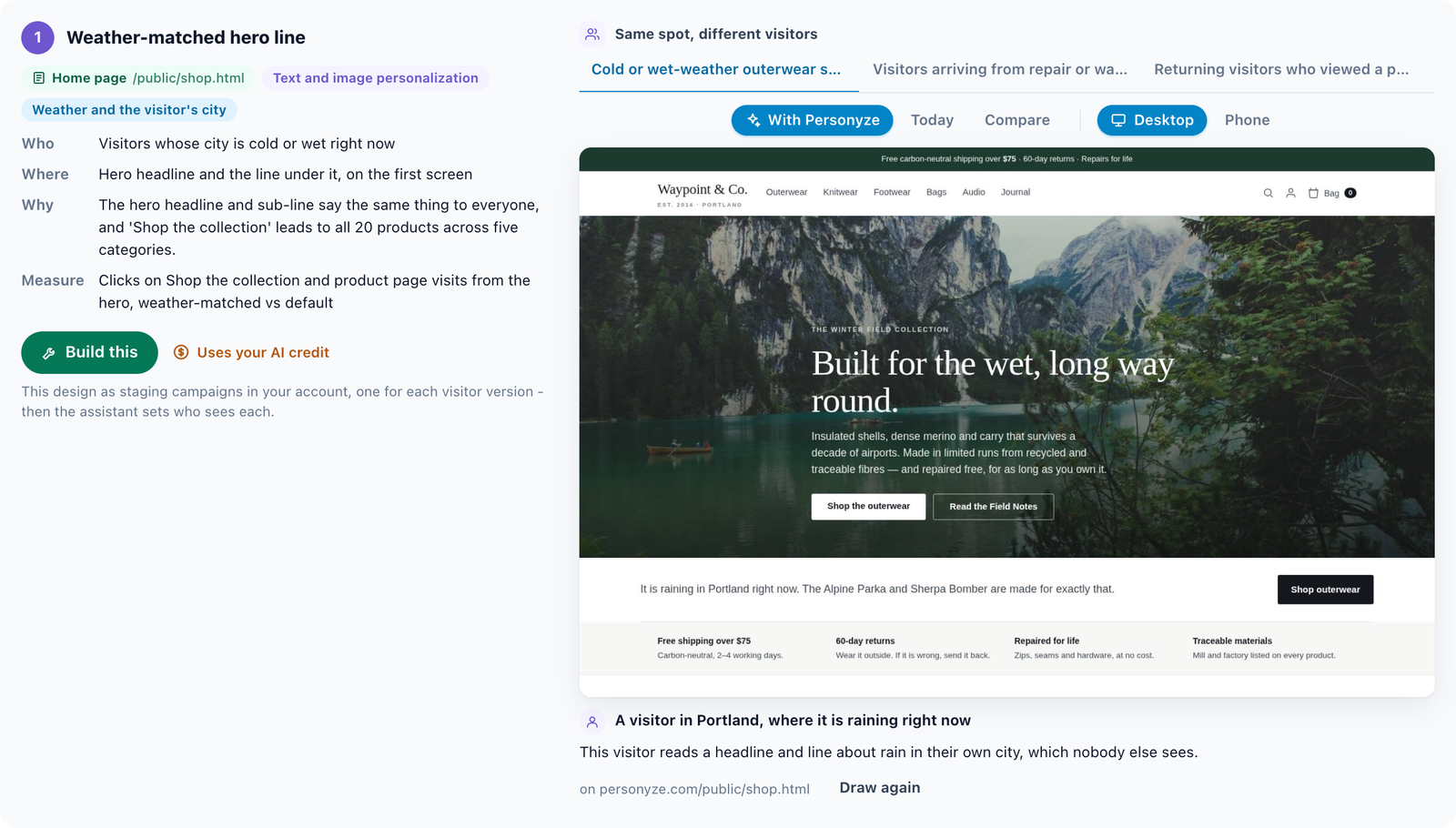
The best ideas come with a mock-up: the idea drawn on a picture of your real page, matching your fonts, colours and buttons, and using your own products and words.
- Same spot, different visitors. A mock-up is drawn for two or three of the plan’s audiences: one tab each, the idea’s own audience first. Click a tab to see what that visitor would see there, and who they are.
- With Personyze, Today and Compare show the page with the idea, as it is now, or both with a slider.
- Desktop and Phone switch between the two pictures of the first tab’s design.
- An idea without a mock-up has Create mock-up; a drawn one has Draw again. Both use your AI credit.
A mock-up is an illustration: nothing changes on your site until you build a campaign and publish it.
Landing pages
Create landing page designs a whole landing page for an idea’s audience: the page an ad, an email or a personalized link would send them to, in your site’s own look. Make it a real landing page turns it into a hosted Landing page campaign in your account, in staging, which you can connect to your own domain.
Page by page

One short suggestion for every page read: what to personalize there, for which audience, pointing at something on that page. A Standard plan covers up to 20 pages this way, and a Deep plan up to 40.
Findings, audiences, features and pages
- Findings: what the pages show that matters for personalization, and Already doing well, what the site does well already.
- Audiences: each audience with the data that recognizes it, its share of visitors, how relevant the pages are to it today and with the ideas, and which ideas lift it. The shares are estimates. An audience marked Real visitors was found by Audience Discovery in your own visitors; hover the mark for its real numbers (how many visitors, and how much more often they reach the outcome than the average visitor). The mark appears only in an account where Audience Discovery has enough traffic to work with.
- Every feature: every Personyze feature checked against your site, with a reason each: a strong fit, possible, already on your site, or not a fit.
- Pages read: every page read and its kind. The page that matters most for the goal is marked Key page.
Turn an idea into a campaign
- Build this, on an idea with a mock-up, makes the design into real campaigns in your account, in staging:
- one campaign for each visitor tab, with the design exactly as drawn, at the same spot on the same page (in a new placeholder);
- then the AI assistant opens and sets who sees each campaign, asking you what it needs.
The button says Uses your AI credit: the assistant step does. Once an idea is built, its card links to its campaigns. Check them with the campaign preview, then publish them when you are ready. Where the drawing could not find its exact spot on the page, the campaign says so, and you choose the placement in its editor.
- Help me build it, on an idea without a mock-up, asks the AI assistant to build the idea in staging, step by step.
- Make it a real landing page: see Landing pages.
Share a plan
Share makes a link anyone can open, without logging in. Choose Everything, or only some parts: the scores, the findings, the audiences, every feature, which ideas, and whether their pictures come with them. A shared plan never shows what it cost. You can make several links and turn any of them off.
The free scan on personyze.com
- Anyone can scan a site at www.personyze.com/inspire/. It reads up to 8 pages, writes the plan and draws its best ideas, in about four minutes.
- On the finished plan, Keep this plan emails its link to you. A work email also gets the full Standard plan.
- Your free plan follows you into your account. If you sign up for Personyze with the address you left, we email you once: Add it to my account. One click puts the plan in your account’s Inspire me page, pictures included. It doesn’t use up your account’s own free plan. Nothing is added without that click, so if someone else typed your address, simply ignore the email.
Who can do what
The account owner, managers and users can run plans, draw, build and share. A reporting login can open the account’s plans but not make or change them.
AI credit
These use your account’s AI credit:
- every plan after the first free one, and every Deep plan;
- mock-ups and landing pages you ask for;
- the assistant step of Build this and Help me build it.
What a plan costs depends on its depth and the size of your pages. Credit is checked before each step, so a plan stops cleanly if it runs out.
If something goes wrong
- “Couldn’t open the home page” or “it may block automated visits”. Some sites refuse automated browsers or show them almost nothing. Try another page of the site, or a site that allows it.
- “This took too long”. The site was slow to load in our browser. Try again in a few minutes, or try another page.
- Only the home page was scored. The page that matters for the goal couldn’t be found or read, for example on a one-page site. The plan is then scored on the home page alone.
- “The block it was meant for wasn’t found”. The page changed between reading and drawing, so the design is drawn where the page’s content starts. Draw again usually finds it.
- A plan failed. Its card has Run again, which fills the form with the same site, goal and depth.